Wednesday, February 24, 2016

Key GOP Senators Emerge From Meeting: No Hearing For Obama SCOTUS Nom

Evx4xcehe7dvqvkireqe

Key Republican senators on the Judiciary Committee emerged from a closed door meeting in Majority Leader Mitch McConnell's office Tuesday united in their determination not to consider any nominee to replace Antonin Scalia until the next president takes office.
Tuesday was the first full day the Senate was back in session since Scalia's death Feb. 13.
"We believe the American people need to decide who is going to make this appointment rather than a lame duck president," said Majority Whip John Cornyn (R-TN).
When asked if they would start the process after the new president took office or if they would consider doing it in the lame duck session, Cornyn replied "No, after the next president is selected. That way the American people have a voice in the process."
The Republican members of the Judiciary Commitee were unanimous in agreeing not to move forward with any Obama nominee for the Supreme Court, said Cornyn, who was in the meeting. Sen. Bob Corker (R-TN), who was not in the meeting, later said that GOP senators were told at their weekly lunch that the Judiciary Committee Republicans were in unanimous agreement on the strategy.
Meanwhile, Judiciary Committee Chair Charles Grassley (R-IA) and the rest of the committee Republicans sent a letter to McConnell outlining their plan to block any Obama nominee for Scalia's seat.
Sen. Lindsey Graham (R-SC) said that "there's no use starting a process that's not going to go anywhere and we are going to let the next president decide," when asked why there would be no hearings.
When TPM asked if he had political concerns about the decision not to move forward with a nominee, Graham responded."I have zero concerns politically."
"I think this is what they would do," Graham said referring to Senate Democrats. "For them to say they wouldn't do this is a lie."
Sen. Jeff Flake (R-AZ) demurred saying that Republicans were "still talking." The meeting in McConnell's office came not long after he made a speech on the Senate floor vowing to block any Obama nominee.
"Presidents have a right to nominate just as the Senate has its constitutional right to provide or withhold consent. In this case, the Senate will withhold it," McConnell said. "The Senate will appropriately revisit the matter after the American people finish making in November the decision they've already started making today."

http://talkingpointsmemo.com/dc/senate-gop-decides-no-hearing-for-any-obama-scotus-nominee

Benjamin Fulford: Feb 22, 2016: Did a Chinese banker just announce the biggest event in human...


Tuesday, February 23, 2016

Cop Reveals That ‘Planting Evidence And Lying’ Are Just ‘Part Of The Game’

http://cdn.countercurrentnews.com/wp-content/uploads/2016/02/planting-evidence.jpg

One of the editors at the DC Post stumbled across a web site where local law enforcement deputies speak freely and post with 100% anonymity. Officers frequently exchange tactical information, as well as procedural tips and “methods to use to gain compliance of subjects or to arrest them for being difficult,” the Post explains.
One such post, that was entitled “Tricks of the trade – let’s exchange!” was started by a deputy who admitted much more than officers usually do to people outside of their forces:


“I have a method for getting people off the street that should not be there. Mouthy drivers, street lawyers, assholes and just anyone else trying to make my job difficult. Under my floor mat, I keep a small plastic dime baggie with Cocaine in residue. Since it’s just residue, if it is ever found during a search of my car like during an inspection, it’s easy enough to explain. It must have stuck to my foot while walking through San Castle. Anyways, no one’s going to question an empty baggie. The residue is the key because you can fully charge some asshole with possession of cocaine, heroin, or whatever just with the residue. How to get it done? “I asked Mr. DOE for his identification. And he pulled out his wallet, I observed a small plastic baggie fall out of his pocket…” You get the idea. easy, right? Best part is, those baggies can be found lots of places so you can always be ready. Don’t forget to wipe the baggie on the persons skin after you arrest them because you want their DNA on the bag if they say you planted it or fight it in court.”
This prompted the post to try to get in touch with the original poster. Eventually, they made contact.
It turned out that he been “employed as a law enforcement officer for in excess of 15 years. He agreed to speak with us on the condition of anonymity, the condition we don’t ask him about anything he’s done directly, and referring to him by an alias, which we agreed to do.”
Here’s what that interview looked like:
Jeffery Schultz: You posted about arresting people for drugs that they didn’t have. Does planting evidence like this take place at the Palm Beach County Sheriff’s Office?


Deputy Sheriff: Um, yes it does, on a regular basis. Probably every day in my shift. I work nights on the Road Patrol in a rough, um, mostly black neighborhood. Planting evidence and lying in your reports are just part of the game.
Jeffery Schultz: “Did you observe with some frequency this …  this practice which is taking someone who was seemingly not guilty of a crime and laying the drugs on them?”
Deputy Sheriff: Yes, all the time. It is something I see a lot of, whether it was from deputies, supervisors or undercovers and even investigators. It’s almost like you have no emotion with it, that they attach the bodies to it, they’re going to be out of jail tomorrow anyway; nothing is going to happen to them anyway. One of the consequences of the war on drugs is that police officers are pressured to make large numbers of arrests, and it’s easy for some of the less honest cops to plant evidence on innocent people. The drug war inevitably leads to crooked policing — and quotas further incentivize such practices.  It doesn’t help that your higherups all did the same thing when they were on the road. It’s like a neverending cycle. Like how molested children accept that as okay behavior and begin molesting children themselves.
 effery Schultz: Is this taught in your training academy?
Deputy Sheriff: It is not a part of the course work, but many of the Field Training officers give life lessons in how to stay out of trouble or how to stay ahead of a suspect when it comes to planting evidence or writing your reports. My training officer, who is no longer at the Sheriff’s Office, would keep narcotics and a gun in his car in case he needed to put pressure on a suspect. We also regularly review the facts before writing our reports to make sure our reports match the facts as we present them. By doing this, we can present them in any way we want.
Jeffery Schultz: Has anyone ever been caught doing this? If so, what have your top bosses done about it?
Deputy Sheriff: Top bosses? It’s a joke, right?
Jeffery Schultz: No, why do you say that?
Deputy Sheriff: Our top boss, Sheriff Ric Bradshaw, supports this behavior and has for his entire career. As with anything, it depends on who you know in our agency. Last year, we had three deputies on the TAC unit, Kevin Drummond and Jarrod Foster, get caught falsifying information for a warrant. They got a pat on the back for a job well done. Just recently, we had a deputy, I think his name was Booth. He was caught completely lying on a car crash. Back a few more years, our Sheriff was involved a massive coverup of the death of two black deputies. He hid the report for years. This is only the beginning. The Sheriff has been involved in falsification of documents and his underling, Chief Deputy Michael Gauger, has been personally involved in an overtime scandal to steal money from the Sheriff’s Office. Does our Sheriff know about this behavior? Of course he does. We have even had a judge outright accuse my agency of committing fraud upon the court in a public hearing. She was one of the ones who saw through all the lying and covering up our department does to get away with the internal crime committed by deputies on a regular basis.
Jeffery Schultz: What about planting evidence? Does Sheriff Bradshaw support that also?
Deputy Sheriff: Look, what you have to realize is that you do this at your own risk. Most supervisors look the other way, but occasionally some will not. Then what are you going to do if that supervisor writes a memo to IA? It’s better just to keep it to yourself and your road patrol partners or unit partners. It is not something we advertise because we have some supervisors that are angels and don’t have what it takes to do the job. Besides, we don’t brag about what we do because you don’t want those rumors out there. Still, Sheriff Bradshaw was caught a few years back ordering detectives to falsify evidence to implicate a black man in a robbery. This is why when his deputies do get caught in the middle of a scandal like planting evidence or lying on reports, he generally looks the other way and instructs Internal Affairs to sweep it under the run, unless he doesn’t like you.
Jeffery Schultz: You have proof of this?
Deputy Sheriff: It was testimony by his own chief. His own chief made this admission, in addition to making the admission Sheriff Bradshaw used to steal firearms from the evidence room. It was always speculated guns he would steal these were to plant on suspects.
Jeffery Schultz: So, planting of evidence, is this prevalent in law enforcement agencies?
Deputy Sheriff: I can’t speak for other agencies really, because I have been, you know, with the same agency from the very beginning. We have had guys come work here from new places and they always had new creative ways to get things done. So I suppose yeah, it is common everywhere. Our agency is, um, we are being sued for it right now.It will never make it to court though. There is a cap on what you can win from a law enforcement agency of $200k but our Sheriff, well, he regularly settles out of court for much more than that. It is a way to keep the misdeeds of his deputies from ever reaching the light of day. You know, because these settlements, they are all confidential. I could on’y imagine how many millions are paid out in confidential settlements every year. The taxpayer would cry I am sure.
Jeffery Schultz: Get things done?
Deputy Sheriff: Yes. Sometimes we have a guy running his mouth. Or, um, Sometimes we get a tricky situation where no one has broken the law but you know if you leave, well, you will know you just be right back trying to resolve the problem, like at domestic despute. It happens all the time and you can’t force either party to leave but you know violence is imminent after you turn around and go. Well, and then sometimes we get a guy who keeps getting off but we know is guilty for something so deputies get things done. They might find a baggie of narcotics on the suspect and take him in. It’s done every day here and no one asks questions. We get complaints to IA on it all the time but they always make it go away. It’s a team effort and like they say, you can beat the rap, but you can’t beat the ride.”
Jeffery Schultz: You mentioned specifically “implicating a black person.” Does your agency target based on race?
Deputy Sheriff: I wouldn’t say target based on race but is is, you know, um, it is much easier to do this on a black person because they have no credibility anyways. The charges stick better to blacks than to a rich white guy that can afford a lawyer. That is one school of thought. Then you still have the deputies who like doing it to the rich white guys because they say it removes the smug look from their faces. They get their kicks from the power like its a game. Most cops though, they, um… do it to get bad guys off the streets. The last group of deputies do it for personal gain.
Jeffery Schultz: Personal gain? Like what?
Deputy Sheriff: Sometimes a deputy will use the threat of planting, you know, dope on a person to get some cash or something from the perp. Uh, like a few hundred bucks can make the problem go away. It’s pretty rare but it happens. Usually it’s the deputies that live large and need supplemental income. They tend to keep it really quiet because that’s like, you know, really bad stuff. We even had a guy put the suspect in the back of his green and white [patrol car]to drive him to an ATM machine. We were all like ‘what the hell is he doing?’ And another time a deputy arrested a guy for possession after he said he found the baggie on the guy’s floor board. Then he, um,  he didn’t charge the guy in exchange for oral sex from the guy’s wife. I thought that was, you know, really wrong. Taking things just too far. Way to far. But I kept my mouth shut because,  you know, you cross that line even a little and you don’t have the right to complain about those crossing it a bit more.
Jeffery Schultz: This is terrible stuff they are doing. Just terrible.
Deputy Sheriff: Yes, um it can get pretty bad. Most of our deputies wouldn’t ever think of doing that or going that far but a few, you know, there are a few bad apples in every bunch.
Jeffery Schultz: You said “Beat the ride?” What does that mean?
Deputy Sheriff: Yes, it means you might be able to beat the charges against you but you can’t beat spending the night in jail or the trouble of going through the legal system.
Jeffery Schultz: But what about the innocent people? The ones who have had narcotics planted in their possession by a deputy who end up in jail because of it?
Deputy Sheriff: These people aren’t innocent. If we are dealing with someone, there is a reason for it. We don’t really interact with members of the law abiding public.
Jeffery Schultz: Are there any red flags that would indicate someone had been arrested for drugs they didn’t possess or that officers were planting evidence?
Deputy Sheriff: Not really. Planting evidence is done in such a way it can’t be disputed. Before we write our reports, we can review all the evidence. When our fellow deputies write their supplemental reports, they usually wait until the primary officer writes his report and then uses the facts from those reports. There is no independent recollection ever, and this is standard procedure everywhere. Chances are, if you are reading a police report, you are reading a well thought out, well-rehearsed story that has little in common with what actually took place.
Jeffery Schultz: How does this Sheriff keep his job? Don’t the people in your county become outraged?
Deputy Sheriff: The people in our county wear blinders. They don’t care what we do or if deputies are planting evidence as long as they keep believing the lie their crime is going down and they are protected. They only care about themselves and pretty much, that is fine with us. We get some of the highest salaries in the country, incredible benefits and cars that we can use for our personal use any time we want. No matter how bad our deputies think Sheriff Bradshaw is, money talks and as long as it keeps flowing into our bank accounts, we aren’t going to make any waves. And um, it is quite the opposite. Almost every civilian employee of the Sheriff’s Office who voluntarily worked on the Sheriff’s campaign got a nice, shiny unmarked county take home car they use when ever they want and gas paid for by the tax payer. We’re talking like 150 cars or something completely obscene like that. Who is going to want that to go away?
The Post noted that Deputy Joe “went on to say how the leaders, at the Palm Beach County Sheriff’s Office, including Sheriff Ric Bradshaw, threatens street cops if they don’t make enough stop-and-frisk arrests.”
Just as bad, they “also tell them not to take certain robbery reports in order to manipulate crime statistics,” he added.
“Places like Wellington and Boca Raton and other places under contract need to show how the Sheriff’s Office reduces the crime and manipulation of the crime codes is an easy way to do it,” he continued.
Joe also said that command officers routinely call crime victims to intimidate them about certain complaints that are filed.
Are you surprised by any of this?
(Article by Jackson Marciana; h/t DC Post; image by #Op309 Media; image inspiration and title h/t to The Free Thought Project)

http://countercurrentnews.com/2016/02/cop-reveals-that-planting-evidence-and-lying-are-part-of-the-game/#

The Age of Authoritarianism

"I was astonished, bewildered. This was America, a country where, whatever its faults, people could speak, write, assemble, demonstrate without fear. It was in the Constitution, the Bill of Rights. We were a democracy... But I knew it wasn't a dream; there was a painful lump on the side of my head... The state and its police were not neutral referees in a society of contending interests. They were on the side of the rich and powerful. Free speech?

Try it and the police will be there with their horses, their clubs, their guns, to stop you. From that moment on, I was no longer a liberal, a believer in the self-correcting character of American democracy. I was a radical, believing that something fundamental was wrong in this country—not just the existence of poverty amidst great wealth, not just the horrible treatment of black people, but something rotten at the root. The situation required not just a new president or new laws, but an uprooting of the old order, the introduction of a new kind of society—cooperative, peaceful, egalitarian." ― Historian Howard Zinn
© YaLibNan
America is at a crossroads.

History may show that from this point forward, we will have left behind any semblance of constitutional government and entered into a militaristic state where all citizens are suspects and security trumps freedom.

Certainly, this is a time when government officials operate off their own inscrutable, self-serving playbook with little in the way of checks and balances, while American citizens are subjected to all manner of indignities and violations with little hope of defending themselves.

As I make clear in my book Battlefield America: The War on the American People, we have moved beyond the era of representative government and entered a new age—the age of authoritarianism. Even with its constantly shifting terrain, this topsy-turvy travesty of law and government has become America's new normal.

Don't believe me?

Let me take you on a brief guided tour, but prepare yourself. The landscape is particularly disheartening to anyone who remembers what America used to be.

The Executive Branch: Whether it's the Obama administration's war on whistleblowers, the systematic surveillance of journalists and regular citizens, the continued operation of Guantanamo Bay, or the occupation of Afghanistan, Barack Obama has surpassed his predecessors in terms of his abuse of the Constitution and the rule of law. President Obama, like many of his predecessors, has routinely disregarded the Constitution when it has suited his purposes, operating largely above the law and behind a veil of secrecy, executive orders and specious legal justifications. Rest assured that no matter who wins this next presidential election, very little will change. The policies of the American police state will continue.

The Legislative Branch: It is not overstating matters to say that Congress may well be the most self-serving, semi-corrupt institution in America. Abuses of office run the gamut from elected representatives neglecting their constituencies to engaging in self-serving practices, including the misuse of eminent domain, earmarking hundreds of millions of dollars in federal contracting in return for personal gain and campaign contributions, having inappropriate ties to lobbyist groups and incorrectly or incompletely disclosing financial information. Pork barrel spending, hastily passed legislation, partisan bickering, a skewed work ethic, graft and moral turpitude have all contributed to the public's increasing dissatisfaction with congressional leadership. No wonder 86 percent of Americans disapprove of the job Congress is doing.

The Judicial Branch: The Supreme Court was intended to be an institution established to intervene and protect the people against the government and its agents when they overstep their bounds. Yet through their deference to police power, preference for security over freedom, and evisceration of our most basic rights for the sake of order and expediency, the justices of the United States Supreme Court have become the guardians of the American police state in which we now live. As a result, sound judgment and justice have largely taken a back seat to legalism, statism and elitism, while preserving the rights of the people has been deprioritized and made to play second fiddle to both governmental and corporate interests.

Shadow Government: America's next president will inherit more than a bitterly divided nation teetering on the brink of financial catastrophe when he or she assumes office. He or she will also inherit a shadow government, one that is fully operational and staffed by unelected officials who are, in essence, running the country. Referred to as the Deep State, this shadow government is comprised of unelected government bureaucrats, corporations, contractors, paper-pushers, and button-pushers who are actually calling the shots behind the scenes right now.

Law Enforcement: By and large the term "law enforcement" encompasses all agents within a militarized police state, including the military, local police, and the various agencies such as the Secret Service, FBI, CIA, NSA, etc. Having been given the green light to probe, poke, pinch, taser, search, seize, strip and generally manhandle anyone they see fit in almost any circumstance, all with the general blessing of the courts, America's law enforcement officials, no longer mere servants of the people entrusted with keeping the peace but now extensions of the military, are part of an elite ruling class dependent on keeping the masses corralled, under control, and treated like suspects and enemies rather than citizens. In the latest move to insulate police from charges of misconduct, Virginia lawmakers are considering legislation to keep police officers' names secret, ostensibly creating secret police forces.

A Suspect Surveillance Society: Every dystopian sci-fi film we've ever seen is suddenly converging into this present moment in a dangerous trifecta between science, technology and a government that wants to be all-seeing, all-knowing and all-powerful. By tapping into your phone lines and cell phone communications, the government knows what you say. By uploading all of your emails, opening your mail, and reading your Facebook posts and text messages, the government knows what you write. By monitoring your movements with the use of license plate readers, surveillance cameras and other tracking devices, the government knows where you go. By churning through all of the detritus of your life—what you read, where you go, what you say—the government can predict what you will do. By mapping the synapses in your brain, scientists—and in turn, the government—will soon know what you remember. And by accessing your DNA, the government will soon know everything else about you that they don't already know: your family chart, your ancestry, what you look like, your health history, your inclination to follow orders or chart your own course, etc. Consequently, in the face of DNA evidence that places us at the scene of a crime, behavior sensing technology that interprets our body temperature and facial tics as suspicious, and government surveillance devices that cross-check our biometrics, license plates and DNA against a growing database of unsolved crimes and potential criminals, we are no longer "innocent until proven guilty."

Military Empire: America's endless global wars and burgeoning military empire—funded by taxpayer dollars—have depleted our resources, over-extended our military and increased our similarities to the Roman Empire and its eventual demise. The U.S. now operates approximately 800 military bases in foreign countries around the globe at an annual cost of at least $156 billion. The consequences of financing a global military presence are dire. In fact, David Walker, former comptroller general of the U.S., believes there are "striking similarities" between America's current situation and the factors that contributed to the fall of Rome, including "declining moral values and political civility at home, an over-confident and over-extended military in foreign lands and fiscal irresponsibility by the central government."

I haven't even touched on the corporate state, the military industrial complex, SWAT team raids, invasive surveillance technology, zero tolerance policies in the schools, overcriminalization, or privatized prisons, to name just a few, but what I have touched on should be enough to show that the landscape of our freedoms has already changed dramatically from what it once was and will no doubt continue to deteriorate unless Americans can find a way to wrest back control of their government and reclaim their freedoms.

That brings me to the final and most important factor in bringing about America's shift into authoritarianism: "we the people." We are the government. Thus, if the government has become a tyrannical agency, it is because we have allowed it to happen, either through our inaction or our blind trust.

Essentially, there are four camps of thought among the citizenry when it comes to holding the government accountable. Which camp you fall into says a lot about your view of government—or, at least, your view of whichever administration happens to be in power at the time.

In the first camp are those who trust the government to do the right thing, despite the government's repeated failures in this department. In the second camp are those who not only don't trust the government but think the government is out to get them. In the third camp are those who see government neither as an angel nor a devil, but merely as an entity that needs to be controlled, or as Thomas Jefferson phrased it, bound "down from mischief with the chains of the Constitution."

Then there's the fourth camp, comprised of individuals who pay little to no attention to the workings of government, so much so that they barely vote, let alone know who's in office. Easily entertained, easily distracted, easily led, these are the ones who make the government's job far easier than it should be.

It is easy to be diverted, distracted and amused by the antics of the presidential candidates, the pomp and circumstance of awards shows, athletic events, and entertainment news, and the feel-good evangelism that passes for religion today. What is far more difficult to face up to is the reality of life in America, where unemployment, poverty, inequality, injustice and violence by government agents are increasingly norms.

The powers-that-be want us to remain divided, alienated from each other based on our politics, our bank accounts, our religion, our race and our value systems. Yet as George Orwell observed, "The real division is not between conservatives and revolutionaries but between authoritarians and libertarians."

The only distinction that matters anymore is where you stand in the American police state. In other words, you're either part of the problem or part of the solution.

http://www.sott.net/article/312837-The-Age-of-Authoritarianism

The untold story of two small Syrian towns & their three year struggle against U.S. 'regime change'

For 3 and a half years a tiny Shia enclave was besiged by al Qaeda but the West turned a blind eye because the inhabitants stayed loyal to Assad government

Syrian rebels attack the headquarters of Assad's regime forces in the villages of Nubul and al-Zahraa in Aleppo
This is the untold story of the three-and-a-half-year siege of two small Shia Muslim villages in northern Syria. Although their recapture by the Syrian army - and by Iranian Revolutionary Guards and Iraqi Shia militias - caught headlines for a few hours three weeks ago, the world paid no heed to the suffering of these people, their 1,000 "martyrs", at least half of them civilians, and the 100 children who died of shellfire and starvation.

For these were villages that remained loyal to the Syrian regime and paid the price - and were thus unworthy of our attention, which remained largely fixed on those civilians suffering under siege by government forces elsewhere.

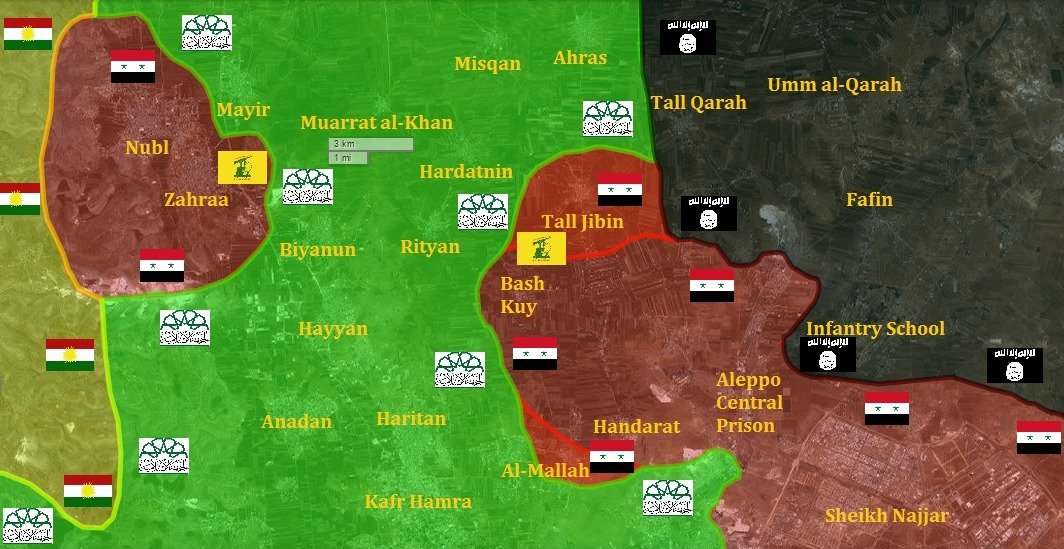
Nubl and Zahra should be an 18-minute drive off the motorway north-east of Aleppo but the war's front lines in the sharp-winded north of Syria have cut so deeply into the landscape that to avoid the men of the Jabhat al-Nusra and Isis, you have to drive for two hours along fields and broken country roads and through villages smashed and groined by the Syrian offensive.

Syrian and Iranian flags now hang from telegraph poles outside the damaged village mosques, a powerful symbol of an alliance that brought these people's years of pain to an end. Among them were at least 100 Sunni Muslim families - perhaps 500 souls - who, way back in 2012 chose to take refuge with their Shia countrymen rather than live under the rules of the Islamists.

The police commander, Rakan Wanous, kept meticulous records of the siege and deaths in Nubl and Zahra and recorded, with obviously bitter memories, the threatening phone calls he took from the Nusra forces surrounding his two villages. Wanous was also officially in charge of many other towns that had fallen to Nusra. Yes, he said bleakly, the calls came from the neighbouring Sunni village of Mayer. "Once, they told me they were going to come and slaughter us - and slaughter me - and I told them: 'Well, let's wait until you get here and see.' On another occasion, they threatened to shower us with chemical weapons."


Relief could not come too soon
Wanous was deeply upset in recalling this. Had some of the calls came from people he knew personally? I asked. "Yes", he said. "The ones who threatened me often were from my own police force. They came from my own policemen - of course, they had my mobile number. Some calls came from sons of my own friends." Of Wanous's 15‑man police force, five stayed loyal to him. The other 10 defected to Nusra.

From the start, Nubl and Zahra were defended by their own pro-regime militiamen, a force perhaps 5,000-strong who were armed with rifles, rocket launchers and a few mortars. Up to 25,000 of the original 100,000 civilian inhabitants managed to flee to Turkey in the early days of the fighting. The rest were trapped in their homes and in the narrow, shell-blasted streets. "We reached a period after a year when we were in despair," one of the local civil administrators, Ali Balwi, said. "We never expected this to end. Many of the civilians died because their wounds could not be cared for. We ran out of petrol early on. They cut off all electricity."

The villages' sole link with the outside world was the mobile phone system that operated throughout the siege so that civilians and militiamen could keep in touch with families and friends in Aleppo. Mohamed Nassif, a 61-year old civil servant, recalled how he had, in desperation, called the UN in New York to plead for help and humanitarian aid for the villages. "I spoke to someone - he was a Palestinian lawyer - at the UN Human Rights office in New York and I asked if there was any way the UN could lift this siege and help us. I asked for humanitarian aid. But they did nothing. I did not hear back from them."


Syrian volunteers aged 50 to 70 in the northern towns of Nubl and Zahra are fighting against forces opposing the Syrian regime
When the siege began, Wanous said, the Syrian government resupplied the villagers with food, bread, flour and medicine. The helicopters also dropped ammunition. There were three or four flights every day during the first year. "Then at about five o'clock, at dawn, on 30 June 2013, a helicopter came to us with some returning villagers from Aleppo and a staff of seven teachers for our schools who were to hold the school exams here," Wanous said. "Someone in Mayer fired a rocket at the helicopter and the pilot managed to steer it away from the village and it crashed on the hillside outside in a big explosion. There were 17 on board, including the pilot and extra crewman. Everyone died. The bodies were in bits and all were burnt. That was the last helicopter to fly to us." The wreckage of the helicopter still lies on the hillside.

But there were Syrian Kurdish villages to the north of Nubl and Zahra and Kurdish fighters from Afrin tried to open a road to the besieged Shia; yet Nusra managed to block them. So the Kurds smuggled food to their Syrian compatriots by night. There are differing accounts of what happened next. Some in the village admitted that food prices became so high that poor people could not afford to eat. The authorities say that at least 50 civilians died of hunger. Fatima Abdullah Younis described how she could not find medicine for her sick mother - or for two wounded cousins who could not be cared for and died of their injuries. "God's help was great for us and so we were patient," she said. "But we suffered a lot and paid a heavy price in the blood of our martyrs." During the siege, Ms Younis learned that her nephew, Mohamed Abdullah, had been killed in Aleppo. She and her husband have lost 38 members of their two families in the war.

But the war around Nubl and Zahra is far from over. I drove along the route from Bashkoi, which the Syrian and Iranian forces took to reach the villages, and found every house, mosque and farm destroyed, the fields ploughed over, olive trees shredded by the roadside. Big Russian-made tanks and trucks carrying anti-aircraft guns blocked some of the roads - driven in one case by Iraqi Shia militiamen with "Kerbala" written on their vehicle - and just to the east of one laneway a Syrian helicopter appeared out of the clouds and dropped a bomb on the Nusra lines half a mile away with a thunderous explosion and a massive cloud of brown smoke. Ramparts of dark, fresh earth have been erected alongside many roads because snipers from Nusra and Isis still shoot at soldiers and civilians driving out to Aleppo.

There seemed no animosity towards the Iranians - whose battledress is a lighter shade of camouflage than the Syrians and whose weapons and sniper rifles seem in many cases newer and more sophisticated that the old Syrian military Kalashnikovs - and you had to talk to the families in Nubl and Zahra to understand why. Many of them had visited the great Iranian shrines in Najaf and Kerbala and several women, including Fatima Younis, had sent their daughters to Tehran University. One of her daughters had - like other young women from the villages - married an Iranian. "One of my daughters studied English literature, the other Arabic literature. My Iranian son-in-law is a doctor," Younis said. So, of course, when the Iranians arrived with the Syrians, they were greeted not as strangers but as the countrymen of the villagers' own brothers-in-law.


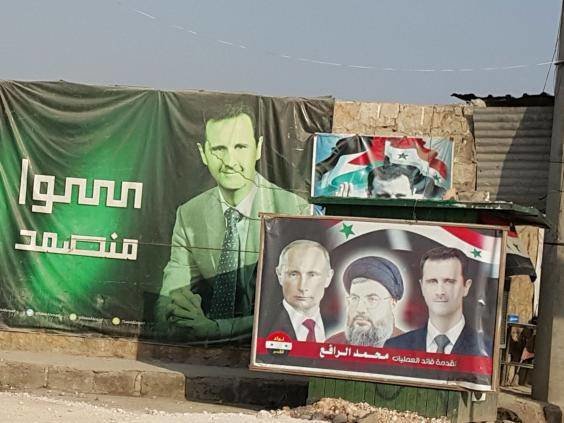
A poster in Nubl featuring Vladimir Putin, Bashar al-Assad and the Hezbollah leader Sayed Hassan Nasrallah
"The foreign forces came to us because they felt our suffering," Younis said. "We appreciated their sacrifices. We are proud of them for helping us. But we are Syrian and we have loyalty for our country. We knew that God would help us." But what of their Sunni neighbours? One old woman holding a grandchild in her arms said it would be "very difficult" to forgive them, but her younger companion was more generous. "Before the attacks, we were like one family," she said. "We didn't expect we would ever have a problem in the future. But we are simple people and we can forgive everybody."

There was no sign of Hezbollah fighters in the villages, although everyone said they accompanied the Syrians and Iranians into the battle. But there was one imperishable sight on the walls: a newly minted poster showing the faces of Vladimir Putin, President Bashar al-Assad and Sayed Hassan Nasrallah, the Lebanese Hezbollah leader. Rarely, if ever, have the forces of Russian Orthodoxy, the Alawite sect and Shia Islam been brought so cogently together.

The men who defended Nubl and Zahra - they also used a B-9 rocket launcher to shoot at Nusra - at first called themselves the "National Defence Force" and then just the "National Defence". It remains unclear whether they were partly made up of pro-government militias - although such units scarcely existed in this region at the start of the war. The police commander, Rakan Wanous, is an Alawite - or, as journalists always remind readers, the Shia sect to which Assad belongs. Indeed, he is the only Alawite in the area.


Comment: Thanks to the intervention of the Russian coalition these brave and forgiving people escaped the fate of no doubt many similar towns in Libya, Iraq, Yemen, and Afghanistan.

Also see:
There can be little doubt in Syria - despite Western denials - that the so-called Islamic State (IS, formerly ISIS/ISIL)) jihadists and related Al-Qaeda brigades in Jabhat al-Nusra, Jaish al-Fateh, Ahrar ash-Sham and so on, have been infiltrated, weaponized and deployed for the objective of regime-change by the US and its allies. If that is true for Syria, then it is also true for Yemen. Indeed, the covert connection becomes even more apparent in Yemen.

The Pentagon's guns for hire: Blackwater, Al-Qaeda... what's in the name?
http://www.sott.net/article/312846-The-untold-story-of-two-small-Syrian-towns-their-three-year-struggle-against-US-regime-change

Monday, February 22, 2016

Anonymous hacktivists share personal info of Cincinnati cops as revenge for deadly shooting

© Hot_Show
After releasing a threatening video, the notorious hacking group Anonymous exposed personal information of 52 Cincinnati Police Department officers in retaliation for the death of an Ohio man at the hands of law enforcement.
In the video posted on Sunday, someone wearing a mask and hood discussed the group’s anger over the Cincinnati PD’s handling of an officer-involved shooting last Wednesday that resulted in the death of Paul Gaston, a black man.
“Greetings world, we are Anonymous Anon Verdict. The following clip you are about to see are three separate cell phone clips of Cincinnati Police Department murdering a black man named Paul Gaston while he held his hands up on February 17th. With the evidence provided it is quite obvious that he was complying and had his hands in the air,” the figure said with a synthesized voice in the three-minute YouTube video.

The video went on to talk about the perceived injustices in US law enforcement, referring to police as a “gang known as the Thin Blue Line.”
The names, ages, email addresses, street addresses and social media accounts of the 52 officers were posted in two links in the video’s description.
The Cincinnati PD is reviewing the situation to determine if there risk to the officers and to discover any breach to their network.
It appears that information about the officers could have been acquired by looking at public records and their social media accounts, according to Lieutenant Steve Saunders. The information was no longer available as of Monday morning, however.

  “When their addresses are put out in the public, that's a concern. I know that we have a section working on that to try to knock down whenever our addresses are put out in a public place like that and that's what the police administration is doing about this," Sergeant Dan Hils, chapter president of the Fraternal Order of Police, told WLWT.
Included in the Anonymous video was cellphone footage of the Gaston shooting, recorded by three different bystanders. Cincinnati police said that Gaston was reaching for something that appeared to be a gun, but some witnesses claim that his hands were in the air before he was shot. The weapon on him turned out to be an Airsoft pellet gun.
In their video, Anonymous compared the incident to another that took place only a day before Gaston’s death, where a white man named Christopher Luagle was pointing a replica gun at police and wasn’t shot.
The two cases were “dramatically different,” police officials told the Cincinnati Enquirer. Luagle’s replica had an orange tip on the end of it, a clear indication that it was a toy, while Gaston’s did not.
Gaston had encountered police after he crashed his vehicle into a pole, and an onlooker called 911 telling him that he stumbled out of the car with a gun and was acting erratically.
Cincinnati police shot and killed the 37-year-old less than half an hour later, when officers say he reached for what appeared to be a real gun on his waistband.

https://www.rt.com/usa/333292-anonymous-hack-cincinnati-police/

Judge Fines Man $1.30 For Growing 30 Marijuana Plants, Says Laws Against It Are ‘Ridiculous’

marijuana

Judge Pierre Chevalier just issued a stunning statement on marijuana prohibition. He said in unequivocal terms, that a man brought before him for the “crime” of growing 30 marijuana plants at his home, should face no more than $1.30 fine.
The ruling was symbolic, but it went beyond the mere gesture when the judge said point blank that the rules prohibiting the man’s action are “obsolete” and “ridiculous.”
Mario Larouche, 46, had been facing possession charges for the 30 marijuana plants kept at home.
The Canadian judge’s ruling was in line with what the new Prime Minister Justin Trudeau and his party have said about legalizing marijuana.
The Quebec judge said this about it all:
We are in a society where people are accused of possession and use of marijuana while more than half the population has already consumed. These are laws that are obsolete and ridiculous. When one is in the presence of laws which would have more than half of the population has a criminal record in Canada… And probably most Crown Attorneys and defense, and perhaps judges, but I will not comment on it.
Then Judge Chevalier explained that “46 year old Mario Larouche had tried numerous times to get a prescription for medical marijuana, unsuccessfully”
There are “so few doctors are willing to prescribe marijuana for pain relief, despite the mountains of evidence proving its effectiveness without the disastrous side effects of prescription painkillers. This forced Mr. Larouche to break the law in order to treat his pain.”
Chevalier said the system itself is broken.
“Monsieur is in a broken system where it does not give people access to a natural medicine that goes back centuries, millennia.”
Do you agree? If you want to see more judges TAKE A STAND like this, then help SPREAD THE WORD!